Dorchester Dropping Mass Market Books

If you’re a romance writer and at all savvy in the ways of the ‘Net and keeping up with news of the industry, you know about Dorchester’s announcement to drop its mass market publishing program in favor of ebooks with eventual trade publication down the line. Or something like that. I’m in the midst of edits for my December 2011 Five Star Expressions release, and while I’ve been following the talk throughout the weekend, I haven’t had time to pay the attention to it that I’d like. What I do know is that I have friends who write for Dorchester, and I feel for them. I hear even the editorial staff was surprised by Dorchester’s decision. But Dorchester has fallen on hard times, and at least the company is trying to do something about it. Whether how they’re going about it will make authors happy remains to be seen. If Dorchester is abandoning the mass market publishing model, does that mean they’ll also abandon advances and offer higher royalties instead? I don’t know. I figure the people who are more likely to discover these things are the people, the writers, who have a vested interest in them. IE. Dorchester authors. And so I’ll hand you over to the likes of Anna DeStefano, a Dorchester author who is blogging about the changes at Dorchester on her blog as she experiences them. She’s doing a great job. The link I just provided will take you to the first in Anna’s articles on the subject.

I admire several Dorchester authors, and I have bought several Dorchester books. In fact, on Friday, just before I heard that the rumor bandied about on Twitter was in fact not a rumor, I received notification from my favorite on-line bookstore that a Dorchester novel I’d ordered was on its way in the mail to me. I expect to receive it this week. And I really want to read it (Book 4 in Gemma Halliday’s High Heel Mysteries series). But maybe I should wrap it in plastic and store it away instead—as one of the last mass market paperbacks Dorchester might ever print.

Who am I kidding? I’ll read it. I love Gemma’s writing.

I’m an epublished author (or “digital author,” if that’s your preference). (“Digital author” makes me think of  little Jack Horner sticking his fingers into a pie, I must say). “Digital first,” as some larger publishers are now calling themselves. That means ebook first, then trade paperback somewhere down the line, whether it’s a month later with the trades printed with Print on Demand technology (basically no warehousing involved) (by the way, this was how my first two cindypks were published with Amber Quill), or digital release (there’s the finger popping out of the pie!) with the trades releasing several months down the line (like Samhain and others; I only mention Samhain because they have a great reputation and I know several of their authors, so I’m familiar that they indeed do publish their ebooks in print several months down the line). Some publishers use POD technology for the trade paperbacks, and others run small print runs.

Okay, so I’m an epublished author, we’ve established that. Why does hearing that Dorchester is dropping mass market sadden me? Because, to me, “mass market” (meaning a printing format) = distribution. And distribution = a greater chance at sales. A greater chance at earning an income beyond what I fondly term The King Family Kraft Dinner Fund. I know a lot of people who pretty much only buy their books in mass market format—at the grocery store, maybe once in a blue moon through a trip to a bookstore. I don’t know many people who order books on-line (I do, because I don’t have to leave the house and I order enough to qualify for free shipping in one go), I don’t know anyone outside of some American writer friends who owns an e-reader or plans to buy one. Yes, this will change as the publishing industry changes. I don’t even own an e-reader yet, but have plans to buy one next year (must wait for a good reason, like a birthday, and my most recent birthday was in January). Yes, as an epublished author who first ventured into the arena ten years ago (I signed my first epublishing contract in 1999 or 2000, but then cancelled it before the book came out because I’d learned some not-so-good things about the company), I’ve been hopeful and waiting for the time when e-readers would come down in price and the public would begin to embrace ebooks. But I didn’t envision that happening at the expense of other publishing models, like mass market. And that, honestly, isn’t what’s happened. The recession in the U.S. has played a major part. I WANT the public to embrace digital publishing, but I don’t like seeing any format disappear. Certainly not a format to which I aspire to publish my books. I’m sad for new authors who recently sold to Dorchester and thought they’d finally achieved their dream of mass market publication, only to discover that all the bucks they’d spent on promotion, etc., might be for naught, because Dorchester’s entire (now trade) print publishing schedule is being pushed back. I feel for authors who have 3 or 4 books out in a series in mass market who are facing the last book in the series getting published “digital first.” Will their mass market readers follow them? If those readers don’t follow them, what will that mean for those authors’ careers? I feel sad for readers who can’t afford e-readers and don’t use credit cards (I know such people), which are useful little items for ordering things on-line. I think, as the industry changes, readers as well as writers will get caught in the crunch. We are living in exciting times…as long as you aren’t personally affected by it. We’re living in exciting publishing times…you know, when you look back on it fifty years hence and can think, Hey, wasn’t that kind of like when the whole Gutenburg thing happened? And I was part of it. Cool. But right now, the times, they are uncertain. Authors careers, they are uncertain. If you are a reader and you have a favorite author, the best thing you can do for them is support them and buy their books new. Not from a used book store and, for heaven’s sake, not by downloading “free” ebooks from a pirate site. Those “free” ebooks are illegal copies and authors don’t earn one penny from those downloads. Authors don’t earn money from non-existent “sales.” If authors don’t earn money, publishers might axe them—because publishing is a business and businesses like to make money. If publishers don’t earn money, then they might drop entire publishing programs. And if you like to buy your books from the grocery store, then that WILL impact you.

Okay, I’m rambling. I’ll admit it. Time to stop. I don’t know if anything I’ve said here makes sense. The publishing industry is changing, not all of it for the good, and as an author I need to learn as much as I can about those changes. And I need to adapt and change along with them. Which I intend to do. But first I have to honor my contract and get those edits in under deadline. Because I’m a writer, and that’s the way we roll.

~~~~

UPDATE! Dorchester now has some information about the transition to their new publishing program on their website.

Irrecovability

By Kris Kennedy

The thing that can’t be undone. Ringing the bell that can’t be unrung. It means you’re committed. In for the long haul. The act, however unconsidered it was at the start, is now binding.

I believe this is one of the things we seek in our stories. Oh, it’s among other things, of course. But one of the reasons great fiction moves us is because we see characters doing things that we ourselves often back away from: being irrevocable. Doing the thing that can’t be undone.

For good or ill, that’s one of the most exciting parts of reading—and writing—fiction.

It’s part of the reason why the characters in novels don’t do the mundane tasks of their lives on stage. Things like cleaning the house don’t matter, in terms of Story. (Did you hear that? Just tell your family cleaning the toilet doesn’t have a fundamental turning point within, so you’re giving it up.) Most of the mundane tasks of daily life are revocable. Nothing ‘turns’ on them. You could take them back, and no one would know or care. Nothing is fundamentally different as a result. They’re forgettable.

They never make a difference.

(In fact, cleaning is the the antithesis of irrevocable. At least in my house.)

You can walk away from a clean OR a dirty toilet. That is…unless you found a diamond ring resting there, after you’d pushed back the hair from your sweaty forehead with a forearm and knelt to scrub your 20th toilet of the week. And then you saw it. Sparkling. A diamond ring. Diamond rings don’t grow in toilet bowls, so that means someone lost it. Or tossed it. And you found it. And your rent is a month overdue.

NOW you have a story. Now you have a protagonist. Someone with a choice to make.

Make the right ones and you have a hero. Or a heroine.

In all our ‘keeper’ books, one of the things we generally find is characters actively getting themselves deeper and deeper into worse and worse trouble, particularly with the hero/heroine, and there’s simply no backing out. Nothing they do can be reversed.

Sometimes this is hard for us as authors. We like our heroes and heroines. We know their histories, their full potential and their pathetic pitfalls. We love them. Or at least really like them.

In any event, we want them to have a happy life. We don’t want them to be thrown to the wolves. To feel despair. To have Dark Nights of the Soul. To say ‘no’ when it’d be safer to say ‘okay, fine.’ To walk the plank. To face the witch in her very own castle, surrounded by guards, with nothing but a scarecrow to protect them.

But we’ll do it.

For you, the reader.

Because in the end, we’re storytellers. We know heroes and heroines have to walk through the fire. Happy, easy things happening to nice, good people, all of which can be taken back at the first sign of discomfort, is not drama.

Drama means conflict. And that means being committed. Doing, at least once, something that cannot be undone, ever.

Check out the books on your ‘keeper’ shelves. I’ll bet you can find at places the characters made irrevocable, un-take-back-able choices. Decisions that, even if done in the spur of the moment—especially if done in the spur of the moment—pushed them closer to the dark edge of What They Known, then straight off the cliff, into peril and danger and their own worst fears. Right in the other person’s arms.

Come share a moment of irrevocable choice in a book you’re reading or have read. A classic or an unknown. And to the writers out there, how about from a story you’re writing? Why does that moment feel powerful to you, as the reader? What is irrevocably different after that choice, and why do you think it makes the story better?

Or, if you could re-write a scene from a story you’ve read, to include an irrevocable choice, what would it be? Something they can’t take back, and will change everything to come after.

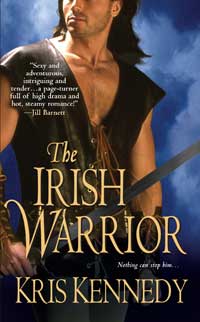
I’m giving away a copy of my latest release, THE IRISH WARRIOR, to someone who gives a great example of irrevocability in romance fiction!!

***

Please leave a comment to enter to win THE IRISH WARRIOR. If you’re reading this blog through a feed at Facebook, Goodreads or another social network, please note you need to leave your comment at www.museinterrupted.com to enter.

Kris Kennedy Guest Blogs Tomorrow!

Tomorrow I’ll welcome historical romance author Kris Kennedy to the blog. Join us for your chance to win Kris’s June 2010 Kensington Publishing release, THE IRISH WARRIOR, which won the 2008 Golden Heart® Award for Best Historical Romance.

About THE IRISH WARRIOR:

Ireland, 1295

Inhibited, accountant-minded Senna de Valery comes to Ireland to finalize a deal that will save her faltering wool business. What she gets instead is a cunning English lord with dangerous ulterior motives.

Forced to rely on her wits, not her ledgers, Senna frees an Irish warrior chained in the prisons, and together they flee across the war-torn land of medieval Ireland. But Finian O’Melaghlin is much more than a charming, roguish warrior. He is councilor to his king, on a grave mission to recover military secrets, and has a dangerous agenda of his own.

Neither is prepared for the powerful forces arrayed against them…

Neither can resist the fiery passion igniting between them…

Neither can imagine the sacrifices they will face, nor the choices they will be forced to make…

King and outlaws, weapons and war: Can love indeed triumph over all?

About Kris:

Wife, mom and psychotherapist Kris Kennedy left behind the office for the wilds of medieval England and Ireland. She still spends time trying to tame the wilds of her kitchen and laundry room, but whenever she can drag herself away from that excitement, she writes sexy, adventure-filled historical romances. Her most recent release, THE IRISH WARRIOR, won RWA’s prestigious Golden Heart® Award for Best Historical Romance in 2008 and released June, 2010 from Kensington. Her next book, DEFIANT, comes out May 2011 from Pocket Books.

To learn more about Kris and her books, please visit her website.

Summer Madness

Summer madness has caught up to me. The month of August promises to zip by! If I’m not around here much, that’s why.

I’m behind on the Peru posts. I’d like to say I’ll start posting about Peru again next week, but no promises as it takes me a long time to format the pictures and write the posts. I do have a guest blogger appearing next Tuesday, historical romance author Kris Kennedy. Please drop by for a chance to win her latest release.

I will start up the Peru posts again as soon as I can. After going out of town to celebrate our anniversary last weekend, I’m in writing catch-up mode. Next week I need to devote to putting together ancillary materials for my December 2011 Five Star Expressions release, WHERE SHE BELONGS. Yes, that’s 16 months away, but my editor has the edits ready for me, and I’ll be going through those next week, too.

I guess you could say I’m in my writing cave.

Except I’m also in my summer cave.

Did I mention #1 son had his laptop stolen? Much kerfuffle revolved around that the last couple of weeks.

And #2 is leaving for university soon. When Eldest Son came home, I thought we’d all get to unpacking his boxes and deciding what Y.S. would need for his first year of residence, then repacking them again. Yeah, right. Maybe we’ll start this weekend.

I did a lot of outside painting in July, and I’m not finished. But we need to prep Y.S. for university first.

How’s your summer going? Are you super busy, too?

25 Years!

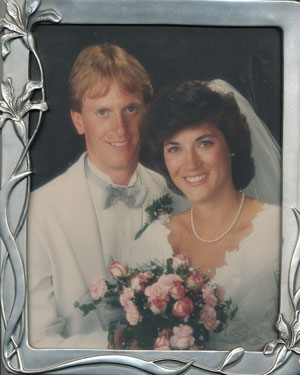
Note to Self: When get married in next life, schedule haircut a few days before ceremony so hair doesn’t bump into new husband’s face in pictures.

It never occurred to me to have my hair professionally done for my wedding. I’d had a perm 6 weeks before the wedding, though. Later, friends told me they would never experiment with a perm 6 weeks before something as important as a wedding (this was 1985—perms were pretty harsh on hair back then). But it was summer, and I wanted a perm. So I got one. It doesn’t look too bad.

Has anyone had a smoothly run wedding day? Our wedding was filled with SNAFUs. As is tradition, I got very little sleep the night before. My family allowed me to sleep in and went to decorate the hall. So of course Jehovah’s Witnesses chose that Saturday to knock on my parents’ door. And I answered. In a bathrobe and a towel on my head. I thought the Witness would understand that it was my wedding day (I told them) and I needed to dry my hair. Nope. They launched right into their spiel regardless. I was polite in expressing that this really wasn’t the time! Then they left.

It was hot as Hades on the day of my wedding, so it’s a good thing I’m not one for foundation. It would have melted off my face. But at least my dress was in order. I don’t know what the deal is now, but in 1985 in Canada you didn’t buy your bridesmaids dresses. You might pay for their fabric if you were feeling particularly generous, but they either sewed their dresses themselves or hired a seamstress. We didn’t think of buying off the rack (small town, zero selection).

My mom sewed my little sister’s dress. My maid of honor hired a seamstress. My second bridesmaid was a childhood friend who’d moved to Montreal with her mom when her parents divorced. Several months before the wedding, I bought her fabric and mailed it to her with the pattern. She was an excellent seamstress. No need to be afeared!

I can’t remember when she called me, but at some point she phoned freaking out and asking if there was any more fabric available. Uh, no. I’d bought the last of the roll at the fabric store. You see, my most excellent seamstress friend had accidentally cut the pattern for a sleeve out of one of the pieces that would form her skirt (still floor-length bridesmaids dresses in 1985; the fashion went to short dresses shortly thereafter). My friend thought I would be horrified. But I wasn’t. “Just sew the sleeve back into the skirt piece,” I told her. After all, the fabric had a design imprinted in the fabric (not sure what you call that, but, you know, it’s textured somehow even though the fabric was all one color), and who’d be looking at her skirt? She wasn’t the bride!

I thought that was it for SNAFUs. I forgot who I was dealing with (me).

The wedding went off without a hitch, except my niece by blood (one of my flower girls, who was 3 or 4 at the time) weeped throughout the ceremony. She thought the music was sad. And maybe she was suffering stage fright. The ceremony was late in the afternoon. I think it was at 5 p.m. or something. The church we were married in was very popular for weddings, and it was a long weekend. But it was August 3rd, and I have a thing for eights and threes. Plus 8 + 5 (’85) = 13, and 13 is my favorite number (because I’m born on the 13th and needed to dispel the myth that 13 is somehow unlucky). I HAD to get married on 08/03/85. There was no other choice!

So off the wedding party went to the photographer’s studio. We hadn’t hired a professional to follow us throughout the day. I thought that was overkill. All I needed were a few studio photos. Candids I could get from family and friends. But the photographer wasn’t there! He’d had another wedding that day in a nearby town, and he was 30-45 minutes late for our session. Meanwhile, we had a tiny window between ceremony and reception, because the wedding had been at 5 p.m. And this was in the days of no cell phones. I can’t remember, but we might have just sat there waiting. Someone might have trucked to a pay phone and called his home to find out where he was. I can’t recall!

He arrived, and the photos went off without a hitch. Except my blood niece cried throughout her pictures. She’s super cute, though, so you can’t tell in the photos. The wedding party whisked off to the reception. And then we had to deal with…the receiving line.

Receiving lines went out of fashion with floor-length bridesmaids’ dresses a year or two after our wedding. I have no clue if the fashion has ever returned. For those who don’t know, the receiving line is when the entire wedding party lines up and the guests shake everyone’s hands and kiss the bride. Usually, you arrive at the hall and the receiving line is there waiting to, well, receive you. But all our guests were already at the hall, because we were so late.

My mother asked me if I wanted to go ahead with the receiving line, because the caterer was getting nervous about dinner. Especially because some of it was fish (a lot of my mother’s family are vegetarians). I insisted we do the receiving line. Silly me! Because the receiving line went on and on and on. At some point I was informed that dinner HAD to be served. The receiving line continued while the first guests got their dinner.

You know how at weddings you cross your fingers that your table will be one of the first to get called? But of course the head table, with the bride and groom, gets served first. I thought, at my own wedding, I would finally get served first. Nope. Several tables had their meals before my new husband and I even had a chance to sit down.

From thereon in, everything proceeded smoothly. My maid of honor’s father break-danced. We had a live band, and they were wonderful (live bands quickly went the way of receiving lines and long bridesmaids’ dresses a couple years later, but we PARTIED ON!). We danced to Downstream by SuperTramp (beautiful song). My maid of honor, known around these parts as Claudia, changed out of her bridesmaid dress into shorts and a top so she could “have fun,” as she put it. I counted myself lucky she and the best man didn’t switch clothes. Because, yes, Claudia and the best man did this at another wedding where she was maid of honor.

My new husband and I arrived at the hotel fairly late. I had elected not to visit the hotel earlier that night and change into “going-away” clothes. I thought that was overkill. But when we arrived at the hotel, the night clerk was aghast. We’d apparently already checked in. There I was, in a wedding gown with a veil and a train. My dh was in a tuxedo. “But the young couple who checked in looked so happy!” the desk clerk said. No doubt. They’d just finagled their way into our wedding suite. I guess my gown convinced the clerk, because he gave us a key. Turned out my new sister-in-law and her husband had written in lipstick all over the mirrors and they might have also done something to the bed. More power to them for getting past the clerk! We, um, went on to enjoy the night. Years later, I learned that a lot of couples don’t “enjoy” their wedding night. Apparently, they think it’s overkill. It’s good to know I have my priorities in order.

My parents had a small houseboat at the time, which they allowed my dh and me to use for our honeymoon. When we arrived at the yacht club where the houseboat was moored, it was stuffed FULL of balloons. Very cool. Except we had to pop a bunch.

The honeymoon was fantastic for 1 or 2 days. Then a huge storm chased us 30 miles back down the lake, and we had to cut the honeymoon short.

A couple months later, a teenager set fire to the pulpit in the church in which we were married. The church burned to the ground, and now a strip mall resides there.

Top that!

Peru, Days 13-14: We Get in Hot Water En Route to Machu Picchu

Aguas Calientes, that is.

Ha ha, I’m so clever! (Not.)

Aguas Calientes is also known as Machu Picchu Pueblo, which basically means “town of Machu Picchu.” On Day 13 of our travels, we woke at our hotel in the Sacred Valley eager to get to the train that would take us to Machu Picchu. We had decided against hiking the Inca Trail. We’d actually decided this a year earlier while researching our trip. You can’t just decide to hike the Inca Trail on the spur of the moment, because it’s not something you can do on your own. You need to go on an organized tour, and only a certain number of people are allowed to begin the trek each day. Also, hiking the Inca Trail takes 3-5 days. That would have consumed a big chunk out of our 3 weeks. We most definitely would have been forced to chuck one of the four legs of our trip. I asked the DH during planning, and he didn’t seem to care about doing the trek. I cared. I didn’t want to do it! We were in a bad car accident 19 years ago this summer, and I’ve suffered neck and back and hip problems since. Honestly, I recovered from the car accident long ago. I didn’t have therapy of any kind for a solid year. But then I started writing consistently…and of course I aged (it’s a curse). I presently go to massage therapy every other week so I can do things like paint the deck and run with the dog and work at a computer. I couldn’t imagine hiking the Inca trail without my very own personal massage therapist!

Pre-car accident, I would have done it. However, I was younger than 30 pre-car accident, too. I like to think that pre-40 I would have wanted to hike the trail, too. But who am I kidding? I’m not an athlete! And I thought that people carried their own packs on the trail. They don’t. Peruvian porters carry the tents and food, etc. The porters set up camp and cook for you. The trekkers carry their cameras or whatever else they want in small day packs. Typicaly, in Canada, this is not one’s idea of “hiking” a trail. Or so we liked to tell ourselves whenever we overheard others congratulating themselves on making the trek. Oh, yeah, carry your own stuff instead of making some little Peruvian guy do it and THEN we’ll talk. (Yeah, I know, sour grapes, because I’m decrepit).

We met many people in Peru who had hiked the Inca Trail, including a couple in their 60s. Cusco is at about 11,000 feet elevation. However, Machu Picchu is at about 8000 feet elevation. The trek goes up and down, up and down, and then you finally emerge with (if you want) a dawn view of Machu Picchu. However, watching the sun rise over Machu Picchu can also be tricky…because there are so many clouds drifting around the sanctuary. More on that in a bit.

The train to Machu Picchu takes about 90 minutes. The train crawls! It crawls because the scenery is so spectacular. It’s hard to take good scenery pictures out a train window, so you’ll have to take my word for it.

Because of the floods earlier this year, the train to Machu Picchu started further up the line than normal (they were still repairing the rails). At one time, it ran out of Cusco. In the mid-Seventies, my parents took the train from Cusco to Aguas Calientes. But now it’s faster to bus tourists to the train start point.

We were picked up at our hotel and driven to a shuttle bus in the new part 0f Ollantaytambo. The shuttle bus took us to the train station. From there, we caught the train.

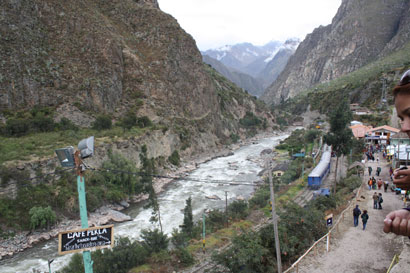
The river that flooded early in the year, view from the train station. When our train was ready, we walked down to where you can see folks walking on the road. This was also where you could watch the porters and trekkers start out on their Inca Trail treks.
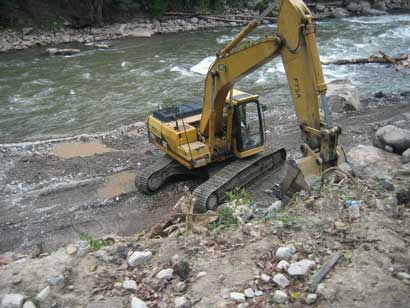
Looking out the window of our train. Repairs from flood damage were still occurring. We saw many stretches of broken tracks before we boarded the train as well.
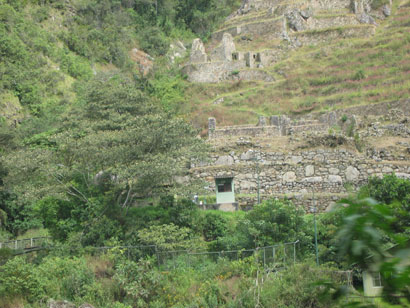
One of the many ruins we passed during the train ride to Aguas Calientes. Honestly, there are so many, it's feels like they're in some people's back yards.

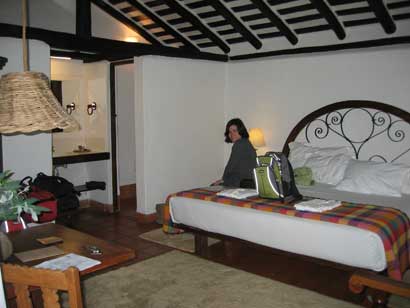
We reached Aguas Calientes without incident (no surprise floods!) and settled into our hotel, the very delightful Inkaterra Hotel. This place was like something out of Swiss Family Robinson. It was gorgeous. We had a very private room, the grounds were expansive, with a good restaurant (meals included, but not drinks), and birds and flora and fauna abounded. Honestly, we could not have afforded to stay at the Inkaterra if not for our tour, which included 5-star hotels (better price through a tour). Every other hotel we stayed in on this tour—in Lima, Cusco, and the Sacred Valley—was part of the Casa Andina Private Collection chain. That chain was…okay. The hotels themselves were very, very nice. But our rooms were the, um, bottom of the scale, shall we say, for 5-star hotels. I wouldn’t call the rooms themselves anything special. Except for at the Inkaterra. It was like a little piece of paradise to return to after a long day of walking around Machu Picchu (we did 8 hours of nearly solid walking).

Our room at the Inkaterra hotel in Aguas Calientes. I slept well that night!

We had no idea that meals were included in the hotel cost when we arrived, so that was a pleasant surprise. As I’ve mentioned, drinks aren’t included, and if you’re a big drinker, you gotta watch out. Because when you check out of the Inkaterra, they tack on a hefty “donation” for the upkeep of the birds (which, honestly, could fly away if they wanted) and flora and fauna. The “donation” is a percentage of whatever you spent on booze and wine. The “donation” is voluntary, but you don’t know that if you don’t ask. If you receive your bill and are the type to just pay it without reading the fine print, you might think there’s no way out of this rather hefty surcharge. There is. You can choose not to donate…and feel like a cheapskate. We chose not to donate, because we had been leaving very nice tips and didn’t realize tipping wasn’t expected. We donated to our waiters instead of the birds and flora and fauna. I know, we’re bad.

To be honest, we gave the hotel a little extra. But not the 25% or whatever it was they tacked onto your bar bill.

I’m sure you can find your own Trip Tip! in there somewhere. I don’t have to spell it out for you, do I? Oh, all right.

Trip Tip! Read the fine print. Ask for translation of the fine print if necessary. Go ahead and feel like a cheapskate if you’re not comfortable with the fine print. It’s okay!

After a very nice lunch, we rested and then walked into Aguas Calientes. It started to rain. It rained and rained. It rained like Oregon-coast rain. Yes, we were in the rain forest. It was pretty hard to miss. We were told that the rain was “unusual” for the time of year (3rd week of May). We did get a teensy depressed that our visit to Machu Picchu the following morning would be marred by rain. We borrowed umbrellas from the hotel and went to bed telling ourselves that at least we could check out the amazing Inca drainage systems (except we’d already checked them out at Ollantaytambo).

We had a meeting at around 7 in the evening with our guide. We told him we wanted to go to Machu Picchu early, so we could watch the sunrise. He assured us that the sun rise didn’t occur until 7 a.m., and besides, the first bus to Machu Picchu didn’t leave until 6 a.m. Truth be told, you can watch the sun rise earlier over Machu Picchu (just not in the specific location to which our guide was referring), but you had to be standing in line at the gates at something like 4 a.m. for the privilege. If you wanted to hike Huayna Picchu, the famous peak you’ll see in the photos below, you also had to line up at 4 a.m. When my parents visited Machu Picchu in the mid-Seventies, you didn’t have to get up at 4 a.m. and you didn’t have to stand in line. That’s because you were one of a handful of people there. Now, in high season (which was just coming up, luckily we missed it), there’s something like 3000 tourists a day. Peruvian Disneyland!

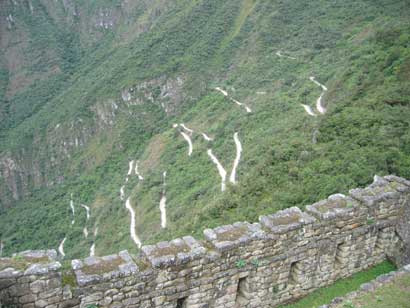
The road the 6:30 a.m. bus traveled to get us to the gates of Machu Picchu. You can walk the road at 4 a.m. if you're a keener. That way, you can get in the line to climb Huayna Picchu. Only two groups of people are allowed to climb Huayna Picchu each day. The first group of 200 starts the hike at 7 a.m. and the second group of 200 starts at 10:00 a.m.

By the time we arrived at the gates to Machu Picchu (where you could show your passport and get a stamp, which made it feel even more like Peruvian Disneyland, but who cares?), the two groups had already been filled. We were a bit surprised to learn this…even though I’d been told by friends and had read about it. We’d hoped to be part of the 10 a.m. group allowed to hike Huayna Picchu and felt that our guide had fed us a bit of erroneous information, because his idea of “sunrise” and OUR idea of “sunrise” (i.e. it’s dark and then the sun rises) were two different things. HIS idea of sunrise was the sun had already arisen but hadn’t risen over a specific point at Machu Picchu. At first we figured the guy just didn’t want to get up at 4 a.m. to accompany us. In retrospect, he didn’t want to walk up that road that we traveled by bus! And I can’t say that I blame him.

But guess what? It wasn’t raining! It had started raining two or three days before we arrived in Aguas Calientes. We didn’t have a hot day at Machu Picchu, but we didn’t have a rainy, either. Considering we thoroughly explored the place for 8 hours with a very short lunch break (we had the guide for 2 hours and the rest we did on our own), we had the perfect weather. And the clouds were covering the guide’s version of the “sunrise,” anyway. So there. Even if we’d hiked up to the gates at 4 a.m., there was no sun to watch rise!

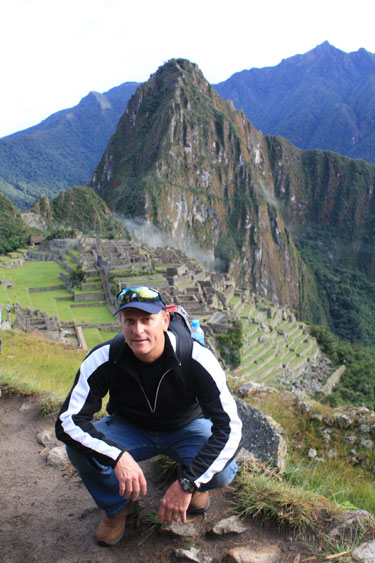
The "postcard" view of Machu Picchu. The peak in the background is Huayna Picchu. Considering I was just beginning to recover from my health issues, it's probably a very good thing I didn't get to the gates early enough to line up to climb it! As it was, we had to climb tons of steps to get to this point.
Here's another of Steve, just because he's cute.

Another way to ensure you’re at Machu Picchu early is to stay at the Machu Picchu Sanctuary Lodge. It’s right outside the gates. It’s VERY expensive, and, honestly, with the number of tourists hanging around outside the Lodge (at the gates) all day long, I’m not sure how pleasant your stay would be. I’ve since talked to another writer who did stay at the Sanctuary Lodge specifically so she and her husband could watch the sun rise over Machu Picchu. But! The clouds covered the sun.

I’d stay at the Inkaterra and take the bus up the winding road again in a Peruvian minute.

Tons of pictures! But this post is way too long. We’ll get back to it next week. Adios!